

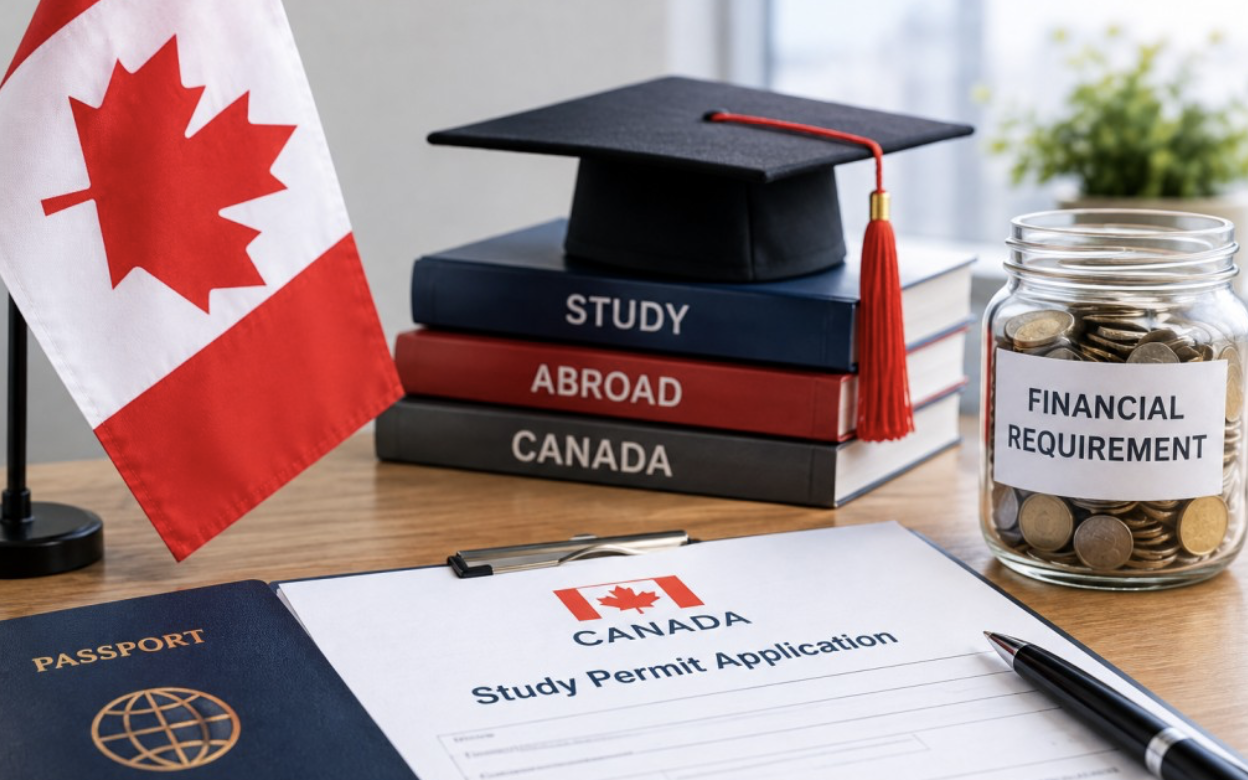
One of the most important parts of a Canadian study permit application is proving that you have enough money to support yourself while studying in Canada.
International students must demonstrate that they can pay their tuition fees, living expenses and transportation costs without depending on employment in Canada to fund their studies. Immigration, Refugees and Citizenship Canada (IRCC) also considers the source of the funds and whether the money will remain available throughout the period of study.
For students applying in 2026, the financial requirement has increased compared with previous years. Understanding the current amount, what it covers and which documents can be used as proof of funds can help applicants prepare a stronger study permit application.
APPLY TO STUDY IN CANADA TODAY
What Is the Proof of Funds Requirement for a Canada Study Permit?
Proof of funds is evidence that you have sufficient financial resources to study and live in Canada.
IRCC requires study permit applicants to show that they can pay for:
- Tuition fees
- Living expenses for themselves
- Living expenses for accompanying family members
- Transportation to and from Canada
- Other reasonable costs associated with their stay
The financial requirement is not simply about having a specific amount of money in a bank account. IRCC assesses the overall financial situation, including the availability and source of the funds.
How Much Money Does One Student Need in Canada in 2026?
For study permit applications submitted on or after September 1, 2026, a single student applying to study in any Canadian province or territory other than Quebec must show CAD $23,448 per year for living expenses.
This amount:
- Applies to one person, including the student
- Covers living expenses only
- Does not include tuition
- Does not include transportation to or from Canada
Therefore, an applicant generally needs to demonstrate funds for tuition + CAD $23,448 in living expenses + transportation costs.
2026 Living-Expense Requirement Outside Quebec
| Family members, including applicant | Required annual living expenses |
|---|---|
| 1 | CAD $23,448 |
| 2 | CAD $29,192 |
| 3 | CAD $35,888 |
| 4 | CAD $43,572 |
| 5 | CAD $49,419 |
| 6 | CAD $55,736 |
| 7 | CAD $62,054 |
| Each additional person | CAD $6,318 |
These figures are for applications made on or after September 1, 2026 and exclude tuition and transportation.
Example: How Much Should a Student Show?
Suppose your first-year tuition is CAD $20,000 and you are travelling to Canada alone.
Your financial planning would include:
- First-year tuition: CAD $20,000
- Required living expenses: CAD $23,448
- Transportation: Additional amount based on your circumstances
This means your demonstrated financial resources would need to cover at least CAD $43,448 plus transportation, assuming CAD $20,000 is the applicable first-year tuition.
The actual amount will vary according to your tuition, travel costs and family situation.
What If Your Program Is More Than One Year?
Students enrolled in programs longer than one year must not only demonstrate sufficient funds for their first year but also explain how they intend to finance the remainder of their studies.
For example, you may demonstrate future financial capacity through:
- Continuing employment of a parent or sponsor
- A scholarship covering multiple years
- Education financing
- Savings and investments
- Other reliable sources of financial support
IRCC states that officers assess both the amount of money available and its source, including whether funds will remain available throughout the studies.
What Documents Can Be Used as Proof of Funds?
There is no single document that every student must provide.
IRCC lists several types of evidence that may be used to demonstrate financial capacity.
1. Bank Statements
Bank statements are one of the common ways to demonstrate available funds.
IRCC indicates that applicants may provide bank statements from Canadian or foreign accounts covering the previous 6 months, including the month of application or the month immediately before it.
Applicants should also provide documentation explaining the source of income or deposits shown in the statements.
2. Tuition Payment Receipts
If you have already paid some or all of your tuition, you can provide evidence of payment.
However, paying tuition alone does not automatically satisfy the financial requirement.
You must still demonstrate that you have enough money for:
- Living expenses
- Transportation
- Any other required costs
IRCC specifically notes that proof of tuition or housing payment should be accompanied by evidence covering other financial requirements.
3. Guaranteed Investment Certificate (GIC)
A Guaranteed Investment Certificate from a Canadian financial institution may be used as financial evidence.
The GIC should be accompanied by other documents where necessary to demonstrate that you meet the complete financial requirement.
4. Education or Student Loans
An approved education loan can also be used as evidence of financial capacity.
Applicants should provide official documentation from the financial institution showing the loan and the amount available.
5. Scholarship or Financial Award
Students receiving scholarships can provide official scholarship documentation.
The documentation should clearly identify:
- The student
- The amount of the scholarship
- The period covered
- What expenses the scholarship covers
If a scholarship covers tuition but not living expenses, additional financial evidence may be required.
6. Sponsor or Family Support
If your parents, spouse, relatives or another person will financially support your studies, you should provide evidence showing:
- Your relationship with the sponsor
- The sponsor’s occupation or source of income
- The amount of financial support
- Evidence that the sponsor has sufficient resources
- Supporting identification or business documentation where applicable
A simple letter saying someone will pay for your education may not provide enough financial context on its own.
Does the Money Have to Be in My Own Bank Account?
Not necessarily.
Funds may come from different legitimate sources, including:
- Your personal savings
- Parents or family members
- Scholarships
- Education loans
- Employment income
- Investments
- Rental income
- Other documented financial resources
The important issue is whether the funds are genuinely available to you and whether you can adequately explain their source.
IRCC specifically states that applicants must provide documentation showing the source of funds appearing in bank statements.
What If There Is a Large Recent Deposit?
Large deposits shortly before submitting a study permit application can require additional explanation.
For example, if your bank account normally contains CAD $5,000 and suddenly receives CAD $30,000, the application should clearly explain where the additional money came from.
Supporting evidence could include documentation relating to:
- Sale of property
- Employment income
- Business income
- Investment maturity
- Education loan
- Family transfer
- Other legitimate sources
The objective is to make the financial history understandable and properly documented.
Can I Use My Parents’ Bank Account?
Yes, parental financial support can be documented.
A strong financial package can connect the student’s application with the parent’s ability to provide the funds.
Depending on the circumstances, supporting evidence may include:
- Parent’s bank statements
- Employment letter
- Recent pay slips
- Business registration documents
- Tax or income documents where appropriate
- Proof of relationship
- Financial support letter
The exact documents can vary depending on the applicant’s country and circumstances.
What About Quebec?
Quebec has its own financial requirements for students seeking a Quebec Acceptance Certificate (CAQ).
Students planning to study in Quebec should follow the financial-capacity requirements established for the CAQ as well as the applicable federal study permit requirements.
The living-expense figures listed above are specifically for provinces and territories other than Quebec.
Do You Need to Show Money for Family Members?
Yes.
If family members are accompanying you to Canada, the financial requirement increases.
IRCC calculates the required living expenses according to the number of family members, including the applicant.
For example, for applications made on or after September 1, 2026, the annual living-expense amount outside Quebec is:
- One person: CAD $23,448
- Two people: CAD $29,192
- Three people: CAD $35,888
- Four people: CAD $43,572
Tuition and transportation are still additional.
Does the Financial Requirement Include Tuition?
No.
This is one of the most important points for international students.
The annual living-expense amount is separate from tuition and transportation.
For example:
First-year tuition: CAD $18,000
Living expenses: CAD $23,448
Transportation: Additional amount
The applicant therefore needs to demonstrate financial resources covering all three categories.
Can You Rely on Working in Canada to Pay Your Expenses?
Your study permit application should not depend on the assumption that you will work in Canada to meet the initial financial requirement.
IRCC requires applicants to demonstrate sufficient funds without working in Canada.
Students may have authorization to work under applicable study permit conditions, but prospective employment should not replace the required evidence of financial capacity at the time of application.
How Does IRCC Assess Your Financial Evidence?
Financial assessment involves more than looking at the final balance of a bank account.
IRCC states that it considers:
- The amount of funds available
- The source of the funds
- Whether the funds are accessible
- Your tuition costs
- Your living expenses
- Transportation costs
- The financial needs of accompanying family members
- Your plan for funding the full duration of a longer program
The goal is to demonstrate that your financial situation is credible and sufficient for your studies.
Common Financial Mistakes to Avoid
1. Showing Only the Living-Expense Amount
Having CAD $23,448 does not necessarily mean you have demonstrated enough money.
You also need to account for tuition and transportation.
2. Providing Unexplained Large Deposits
If your account contains significant recent deposits, provide documentation explaining their origin.
3. Relying on Outdated Financial Figures
The required living-expense amounts are updated periodically.
For applications made on or after September 1, 2026, the amount for one person outside Quebec is CAD $23,448.
4. Ignoring Family Members
If your spouse or children will accompany you, their financial requirements must be included.
5. Showing Funds Without Explaining Their Source
A bank balance without adequate context may leave questions about how the money was obtained.
6. Forgetting Future Years
For programs longer than one year, explain how you intend to finance the remaining period of study.
Canada Study Permit Proof of Funds Checklist
Before submitting your application, review your financial documents carefully.
Financial Documents
- First-year tuition amount confirmed
- CAD $23,448 living-expense requirement considered for one student outside Quebec
- Transportation costs considered
- Family-member expenses included where applicable
- Recent bank statements prepared
- Source of significant deposits documented
- Employment or income evidence included where appropriate
- Sponsor documents included if someone else is funding the studies
- Scholarship documents included if applicable
- Education loan documents included if applicable
- Financial plan for future years prepared for longer programs
How Much Money Should You Show for a Canada Study Permit?
There is no universal single figure for every applicant.
Your target amount should be calculated based on:
First-year tuition + required living expenses + transportation + applicable family expenses
For one student outside Quebec applying on or after September 1, 2026, the living-expense component is CAD $23,448. Tuition and transportation must be added separately.
For a student bringing family members, the applicable living-expense amount is higher.
Final Thoughts
Financial capacity is a central part of a Canadian study permit application. Applicants need to demonstrate that they can afford their education and living expenses without relying on future employment in Canada.
For 2026 applications submitted from September 1 onward, a single student outside Quebec must show CAD $23,448 for annual living expenses, in addition to tuition and transportation costs.
A strong financial package should also explain where the money came from and demonstrate how the student plans to finance the full duration of a longer program.
Preparing clear, consistent and well-supported financial documentation can help make the financial side of your study permit application easier for an officer to assess.
APPLY TO STUDY IN CANADA TODAY
Keywords
Canada study permit proof of funds
How much money to show for Canada study permit
Canada student visa financial requirements 2026
Canada study permit bank statement requirements
Canada international student proof of funds
Canada study permit financial requirements
How much money do I need to study in Canada
Canada student visa proof of financial support
Canada study permit living expenses 2026
International student Canada financial requirements
#Tags
#StudyInCanada
#CanadaStudyPermit
#InternationalStudents
#CanadaStudentVisa
#StudyPermit2026
#ProofOfFunds
#StudyInCanada2026
#CanadaEducation
#InternationalEducation
#CanadianEducation
